
Decriminalization takes on a new meaning when organized crime enters the chat.
Today, roughly $255 million in philanthropic and venture capital funding is helping shape the future of psychedelic medicine in the United States — influencing drug development, public health initiatives, and state and federal policy.
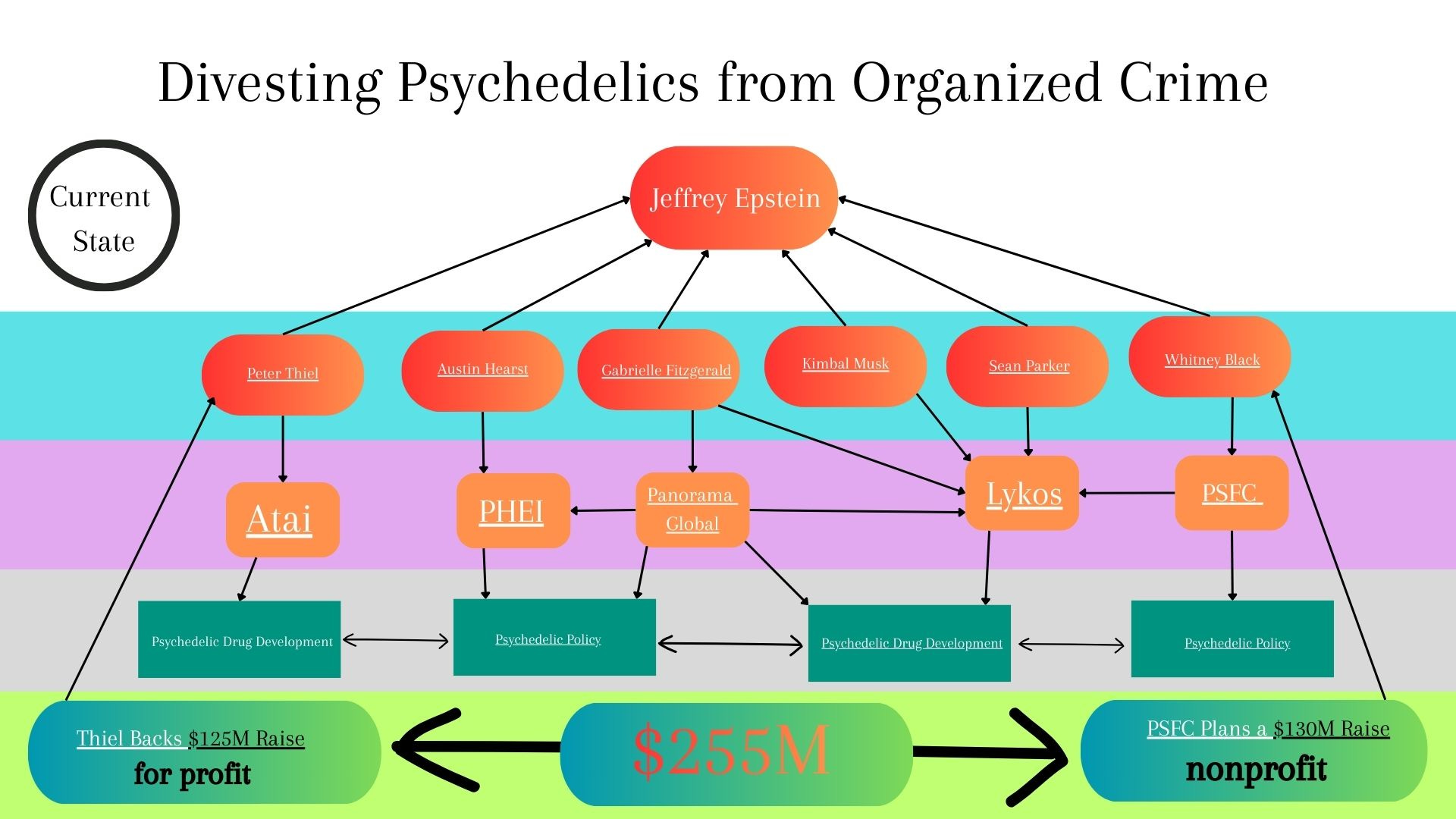
$255M in funding pipelines that intersect with individuals who maintained contact with Jeffrey Epstein.
Roughly $130 million flows through philanthropic initiatives coordinated by the Psychedelic Science Funders Collaborative (PSFC), while an additional $125 million venture capital pipeline has emerged around ATAI Life Sciences, a biotech firm backed by investor Peter Thiel.
Together, these nonprofit and venture capital initiatives represent a quarter-billion-dollar financial ecosystem shaping the development of psychedelic medicine.
This article does not allege criminal conduct.
It raises a governance question:
What happens when financial pipelines shaping a healthcare system intersect with networks connected to organized crime?
Governance Risks in Psychedelic Funding Networks
In addition to his conviction for sex crimes involving a minor, Epstein was investigated for financial crimes involving trafficking networks, shell companies, and illicit financial activity. Publicly released emails show that he continued communicating with prominent figures years after his 2008 conviction.
Within the psychedelic funding ecosystem, at least six individuals who initiated or maintained contact with Epstein after that conviction appear connected to funding pipelines influencing psychedelic drug development and policy.
Identifying governance risk is not the same as alleging guilt. Many people appear in Epstein-related documents in varying contexts. However, proximity to networks associated with organized crime raises legitimate questions about financial due diligence, transparency, and institutional safeguards.
Network Intersections
In an email introducing Epstein to Gabrielle Fitzgerald, the sender warned that Epstein “was notorious for bad press :)”. Fitzgerald subsequently met with him.
DOJ Document:
https://www.justice.gov/epstein/files/DataSet%2010/EFTA02018156.pdf
Fitzgerald later founded Panorama Global, which fiscally sponsors the Psychedelic Mental Health Access Alliance, where Austin Hearst works. Hearst also appears in Epstein contact records.
DOJ Document:
https://www.justice.gov/epstein/files/DataSet%209/EFTA00418028.pdf
Fitzgerald and Hearst later collaborated with PSFC and Lykos Therapeutics on psychedelic access initiatives.
Both organizations intersect with individuals who maintained communication with Epstein after his 2008 conviction.
Meanwhile, donors connected to psychedelic initiatives — including Sean Parker and Kimbal Musk — also exchanged communication with Epstein after 2008. Whitney Black, Chief of Staff to Graham Boyd at PSFC, likewise appears within this broader contact network.
Based on public documents, Panorama Global, PSFC, and Lykos collaborated on the Psychedelic Health Equity Initiative (PHEI), a project designed to expand access to psychedelic-assisted therapy for underserved populations.
PHEI Public Document:
https://static1.squarespace.com/static/6465ebd36812083ef0cf39c3/t/6639b67e5df305386b91f710/1715058323880/PHEI%2BExecutive%2BSummary_APRIL%2B2024.pdf
The initiative highlights disparities in mental health care affecting Black Americans, rural communities, Indigenous populations, and LGBTQ+ individuals, and proposes expanding treatment access for the 84 million Americans covered by Medicaid.
Those disparities are real and urgent.
But addressing them raises governance questions when individuals connected to Epstein’s network occupy positions influencing their funding pipelines.
Money, Governance, and Accountability
Investigations into Epstein’s financial network revealed warning signs commonly associated with organized crime risk, including shell companies with unclear business purposes through which funds could move quietly between entities.
While the name Psychedelic Science Funders Collaborative suggests scientific investment, the organization is organizing a $130 million philanthropic pipeline supporting initiatives including:
• state policy programs
• public health communications
• veteran healing initiatives
• health equity programs
• Indigenous conservation
That funding pipeline is currently being challenged by an open letter requesting PSFC’s dissolution and the redirection of funding toward community-led projects and research focused on sexual trauma, women’s health and other underserved populations:

By definition, health equity initiatives should direct resources toward populations with the greatest unmet needs.
Critics argue that psychedelic research funding remains disproportionately concentrated in studies on white male participants, while many pilot access programs remain financially inaccessible to the communities equity initiatives claim to serve.
The Venture Capital Pipeline
Alongside philanthropic funding, venture capital is shaping the biotechnology side of psychedelic medicine.
ATAI Life Sciences, backed by Peter Thiel, has helped establish a venture capital pipeline estimated at roughly $125 million.
Thiel has previously expressed controversial views about democracy and welfare programs, writing:
“Since 1920, the vast increase in welfare beneficiaries and the extension of the franchise to women… have rendered the notion of capitalist democracy into an oxymoron.”
The contrast is notable.
Nonprofit initiatives connected to PSFC emphasize expanding access to Medicaid-funded care, while a venture capital pipeline supporting psychedelic pharmaceutical development is backed by an investor who has publicly criticized welfare programs that fund those healthcare systems.
Both funding streams intersect with networks that maintained contact with Epstein.
A Defining Moment for Psychedelic Medicine
Roughly $255 million in psychedelic capital remains active within networks intersecting with individuals who had contact with Epstein.
PSFC continues raising funds.
Biotech companies such as ATAI Life Sciences are advancing toward regulatory approval.
The psychedelic ecosystem is entering a defining moment.
The question is no longer whether governance risks may exist.
The question is whether the institutions building this industry will address them.
Protecting Healing Spaces
One of the clearest lessons from Epstein’s network is that sexual misconduct and financial misconduct were deeply intertwined. Exploitation was enabled not only by individuals, but by financial systems that failed to ask basic due-diligence questions.
The psychedelic ecosystem can protect itself — and the people it serves — through transparency.
Organizations operating in psychedelic research, therapy, philanthropy, and policy can publicly publish their policies on:
Sexual Misconduct Prevention
• therapist conduct standards
• patient protection protocols
• reporting procedures
• survivor support mechanisms
Financial Governance
• donor and investment due diligence
• conflict-of-interest disclosures
• financial transparency standards
• anti-money-laundering safeguards
Publishing these policies strengthens institutional credibility, improves governance transparency, and protects organizations from reputational risk originating elsewhere in the ecosystem.
Most importantly, it protects healing spaces from abuse and exploitation.
Consumers can help by requiring these policies before doing business, and funders can help by requiring these policies from the organizations they fund. Collectively, we can help safeguard psychedelic spaces from organized crime.
Sacred Spaces and Trust
Healing spaces have historically been protected environments.
Ancient healing sanctuaries — such as the temples dedicated to Asclepius — prohibited violence within their boundaries. These sanctuaries separated healing from the power struggles of the outside world.
Modern healthcare systems rely on a similar principle: environments where people seek healing must be governed by trust, accountability, and strong ethical standards.
Financial networks connected to organized crime threaten that trust. They introduce reputational risk, regulatory scrutiny, and governance failures that can undermine the credibility of an entire healthcare field.
Psychedelics cannot function both as a medicine for healing trauma and as an ecosystem shaped by financial networks linked to exploitation.
Through divesting psychedelics from organized crime, healing spaces can remain places of trust, integrity, and protection for people seeking healing.